
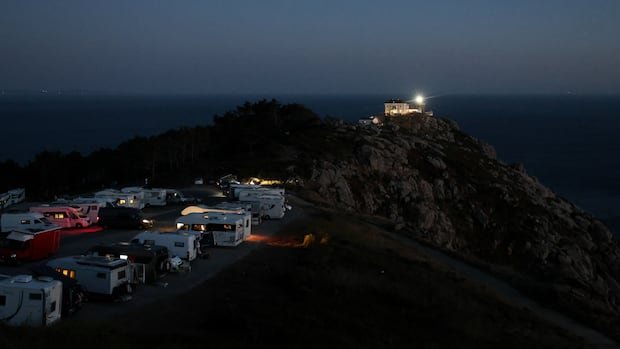

Hundreds of thousands of tourists have flocked to Spain to witness the solar eclipse happening on Wednesday. However, the heightened temperatures and increased wildfire risk in the country have raised concerns among authorities to prevent any lasting fire damage from the surge in astrotourism.
Virginia Barcones, the secretary general for civil protection and emergencies at Spain’s Interior Ministry, emphasized the need to restrict activities that could potentially spark fires due to the ongoing devastating wildfire season. With over 603,000 acres of land already burnt in around 400 fires this year, Spain is facing a critical situation exacerbated by a heat wave affecting Europe since May.
To safeguard against additional fires during the eclipse, authorities are mobilizing 35,000 officers to monitor large outdoor gatherings. Spain, along with northern Russia, eastern Greenland, and western Iceland, falls within the narrow band of totality for Wednesday’s solar eclipse, attracting around 15 million people living in its path.
While only those within the path of totality will witness the complete coverage of the sun by the moon, others, like in Canada, will experience a partial eclipse. Authorities are reminding viewers to use proper eyewear for protection. This solar eclipse marks the first visible from mainland Spain in 120 years, sparking significant excitement and travel.
Special measures have been put in place to manage the expected crowds, with over 660 official viewing sites designated by regional governments to accommodate the influx of over 440,000 people. The eclipse is anticipated to inject over 347 million euros into Spain’s economy, as per a July economic impact study.
Despite the heat wave and wildfire concerns, eclipse enthusiasts remain undeterred, drawn by the rare spectacle nature provides. The eclipse’s impact is not only astronomical but also offers a shared experience that transcends borders and sparks curiosity about the world and its natural phenomena.
Looking ahead, Spain is set to witness two more solar eclipses in the coming years, with the 2027 event expected to further boost astrotourism. This continuous fascination with celestial events not only offers unforgettable experiences but also serves as a reminder of the interconnectedness of global challenges like climate change.
In conclusion, as Spain prepares for the solar eclipse, authorities are vigilant in ensuring safety measures are in place to prevent wildfires and manage the influx of tourists eager to witness this extraordinary astronomical event.