
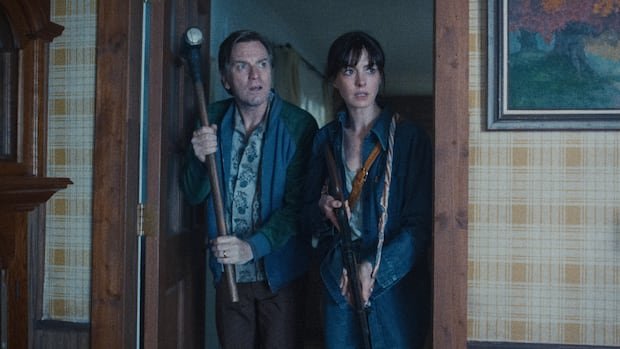

In 1982, the primary concerns of a homemaker might revolve around teenage children socializing, a distant husband preoccupied with work, or peculiar occurrences like strange lights and a dinosaur-like tail in the backyard. Welcome to Oak Street, where a family faces unexpected challenges after their neighborhood is mysteriously transported back to the late Jurassic era.
The End of Oak Street, helmed by director David Robert Mitchell and starring Anne Hathaway as Denise, offers a Spielbergian narrative intertwined with Stephen King-esque elements. The storyline follows the trials of a seemingly ordinary Detroit family, including the father Greg (played by Ewan McGregor), the talented yet despondent Audrey (portrayed by Maisy Stella), and the young sibling Brian (played by Christian Convery).
While the film exudes a nostalgic 80s vibe reminiscent of classic Spielberg works, it falls short of capturing the depth and thematic resonance of its predecessors. Despite being hailed as a summer blockbuster, The End of Oak Street lacks the profound storytelling and character development expected from such a genre.
The movie, although entertaining with its time-traveling dinosaur theme, struggles to offer substantial character arcs amid the chaos of prehistoric creatures wreaking havoc. The rushed pace and focus on action sequences overshadow the potential for emotional depth and meaningful exploration of the family dynamics.
Critics note that The End of Oak Street emulates Spielberg’s visual style but fails to deliver a cohesive narrative or thematic significance. The film’s reliance on spectacle over substance raises questions about its artistic merit and originality in a genre saturated with similar disaster-themed plots.
While the movie delivers on the promise of giant lizards and thrilling encounters, it lacks the depth and innovation seen in similar works like The Drifting Classroom and Testament. Despite its entertaining moments, The End of Oak Street may leave audiences yearning for more substance and a clearer sense of purpose behind the spectacle.
Ultimately, the film’s nostalgic appeal and action-packed sequences may resonate with viewers seeking a straightforward, visually engaging experience. However, the lack of narrative depth and character development raises concerns about the film’s lasting impact and contribution to the sci-fi genre.
In conclusion, The End of Oak Street offers a thrilling yet somewhat shallow cinematic experience, leaving audiences to ponder whether style can truly triumph over substance in the realm of AI-generated entertainment.