
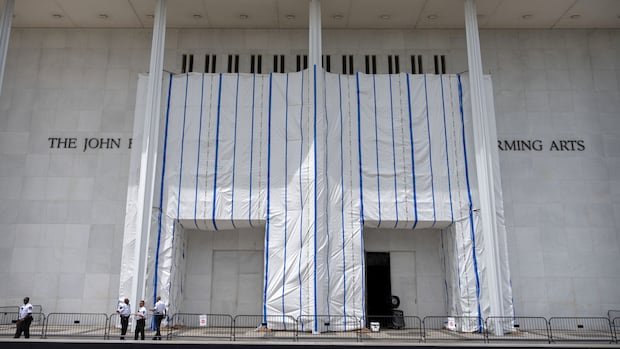

The dispute regarding the future of the Kennedy Center intensified on Thursday as supporters of U.S. President Donald Trump on the board advanced efforts to honor him through physical modifications to the renowned arts venue, potentially defying a court ruling. In a lengthy virtual meeting, the board agreed to insert Trump’s name onto the building’s front, changing it to “The John F. Kennedy Center for the Performing Arts Restored and Renovated By President Donald J. Trump.” Additionally, the plaza in front of the center would be dedicated to Trump, and a significant portion of the venue would be closed for a two-year period to facilitate extensive upgrades.
These actions, as outlined by Representative Joyce Beatty, a Democratic board member from Ohio, and her legal team, represent a significant challenge to U.S. District Judge Christopher Cooper’s authority. Cooper had previously deemed the addition of Trump’s name on the building as illegal and mandated its removal, a decision that the Trump administration unsuccessfully sought to reverse. Moreover, Cooper blocked the proposed two-year closure that was scheduled to begin on July 5, criticizing the board’s initial decision as lacking proper information and appearing predetermined.
Beatty condemned the recent developments as an attempt to circumvent the court’s ruling and violate congressional statutes. She affirmed her commitment to safeguarding the Kennedy Center as a cherished national monument. The Kennedy Center’s representatives did not provide an immediate response to requests for comments on the matter.
A significant portion of the board meeting focused on determining the extent of closures necessary to accommodate the essential renovations vital for enhancing safety at the Kennedy Center. In response to the judge’s concerns about the previous vote, the institution’s leadership pledged to present three closure options for board consideration. These options ranged from a complete shutdown to partial closures that would allow some limited public access and programming in unaffected areas, or a phased closure strategy targeting critical infrastructure needs while maintaining a full programming schedule.
Ultimately, the board opted for a two-year closure of the building while potentially permitting some programming to proceed in an outdoor area known as the Reach. The decision to proceed with the extended closure, coupled with the efforts to honor Trump, may raise doubts about the thoroughness of the board’s deliberations on available alternatives.
In Trump’s second term, the Kennedy Center has emerged as a symbolic representation of presidential authority, a stark contrast to the neglect it faced during his initial tenure in Washington. Upon his return to office in January 2025, Trump swiftly ousted the center’s leadership and installed a new board of trustees with himself as chairman. Despite the initial addition of his name to the building, which was later removed following court orders, Trump’s influence on reshaping Washington, including plans for the White House and surrounding areas, has been notable.
The Kennedy Center leaders emphasize the urgent need for repairs and upgrades within the institution. Matt Floca, the center’s executive director, highlighted severe water damage and outdated equipment during a tour of the building in April. Floca recommended to Trump the comprehensive closure and renovation approach to address these issues efficiently over a two-year period.
As legal battles and physical alterations unfold, the Kennedy Center’s significance is scrutinized, with criticisms and jests interwoven. The institution’s role as a cultural hub accessible to all Americans for artistic enrichment has been underscored by board members, even amidst the contentious changes being implemented.