
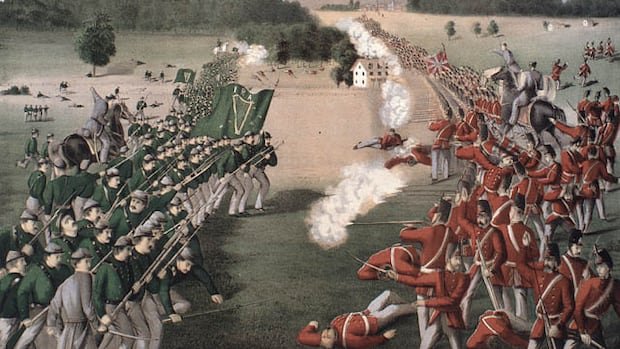

An overlooked clash on Canadian territory just before Confederation might not resonate widely across the nation, but it holds significant historical importance for Fort Erie, Ontario. The 1866 Battle of Ridgeway, also known as Limestone Ridge, marked the first instance of Canadian troops led by Canadian officers engaging in combat. This event also served as the inspiration for Decoration Day, a precursor to Remembrance Day observed in various regions annually. Despite these milestones, the names of the nine fallen soldiers from this battle do not appear in the Books of Remembrance on Parliament Hill.
A recent petition, set to be presented in the House of Commons, aims to include these nine soldiers and the numerous casualties following the battle in the official list. Conservative MP Fred Davies, who represents the Niagara South riding encompassing Fort Erie, expressed the importance of acknowledging those who made the ultimate sacrifice to defend Canada.
The Battle of Ridgeway was not a clear victory for Canada, as inexperienced volunteers confronted Fenian raiders, many of whom were veterans of the American Civil War. The Fenian Brotherhood, an Irish American group seeking Irish independence from British rule, attempted to invade parts of British North America in 1866. Despite being ill-equipped and underprepared, around 800 Canadian volunteers confronted the raiders at Limestone Ridge near Ridgeway and Fort Erie. The Canadian troops faced challenges such as lack of rations, water, proper footwear, and ammunition during what historian Peter Vronsky described as Canada’s first modern battle.
Following the clash and a chaotic retreat, the Fenians retreated back to the U.S. side of the Niagara River, marking a symbolic victory for Canada. Despite the battlefield defeat, the sacrifice of those who perished in the battle remains paramount according to Davies, emphasizing the importance of recognizing their bravery and dedication to defending the nation.
In 2016, a memorial site honoring the nine fallen soldiers from Ridgeway was established, symbolizing the town’s commitment to preserving their memory. Efforts to have their names added to the Books of Remembrance have been ongoing, with Fort Erie Mayor Wayne Redekop stressing the significance of recognizing their contribution to shaping Canada’s history.
Although the battle occurred before the official formation of Canada, the precedent of including soldiers who died before Confederation in the Books of Remembrance exists. The impact of the Battle of Ridgeway on the path to Confederation was acknowledged by Redekop, Davies, and Vronsky, highlighting its role in unifying and defining the Canadian identity.
Several regiments that participated in the 1866 battle, such as the Queen’s Own Rifles and the Royal Hamilton Light Infantry, continue to serve today, reflecting the enduring legacy of that pivotal moment. Alexander Muir, renowned for composing “The Maple Leaf Forever,” fought in the Battle of Ridgeway and drew inspiration from the silver maple tree in Toronto’s Leslieville neighborhood. Vronsky suggested that Muir’s allegiance to the maple leaf insignia of the Queen’s Own Rifles symbolized a shift towards Canadians fighting for their homeland first, emphasizing national identity over colonial ties.
Overall, the Battle of Ridgeway holds a significant place in Canadian history, serving as a testament to the courage and sacrifice of those who defended their nation, paving the way for a unified and independent Canada.