
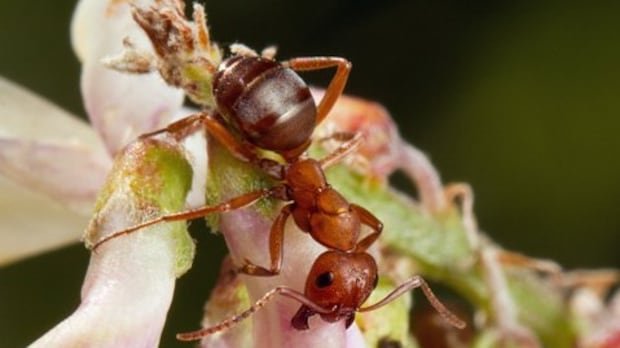

In southeastern Alberta, the Cypress Hills stand out dramatically amidst the vast prairie landscape. Below the eye-catching scenery, a fascinating natural phenomenon unfolds as ants are found clinging to plants and shrubs in Cypress Hills Provincial Park, awaiting inadvertent consumption by unsuspecting herbivores. This peculiar scenario is orchestrated by the parasitic worm, Dicrocoelium dendriticum, renowned for its unique ability to manipulate its host like a zombie.
Researchers from the University of Calgary and University of Lethbridge highlight the exceptional nature of this parasite’s manipulation tactics, noting its unparalleled control mechanism that can be toggled on and off—a rare trait in the realm of parasitic zombies.
Zombie parasites are a common occurrence in nature, affecting various host species across the biological spectrum. The objective behind such parasitic manipulations often revolves around facilitating the parasite’s transition from one host to another. For instance, the Cordyceps fungus, famously depicted in popular media, compels infected ants to climb plants and perish, enabling the fungus to spread its spores. Similarly, the horsehair worm drives crickets to leap into water, ensuring the worm’s reproductive cycle.
Unlike many parasitic relationships that end in the host’s demise, Dicrocoelium operates differently due to its intricate life cycle involving multiple hosts. The parasite’s journey begins in the livers of grazing mammals, such as elk or deer, where adult worms reside. The parasite’s eggs are excreted in feces, consumed by snails, and subsequently ingested by ants, leading to a complex chain of events within the ant’s body.
The challenge arises when the final host, typically avoiding ants, needs the ants to be consumed. To achieve this, the parasite manipulates the ant’s behavior, compelling them to climb plants where they are more likely to be inadvertently eaten. This strategy poses risks to the ants, exposing them to predators, starvation, and dehydration.
The intricate interplay between the parasite and its host extends to temperature sensitivity, with infected ants adhering to plants only under specific temperature conditions. The ability of the parasite to modulate the host’s behavior based on external factors, such as temperature, presents a fascinating mystery for researchers to unravel.
Unraveling the mechanisms behind this parasitic manipulation involves delving into the genetic and biochemical changes occurring within the host. By studying the altered brain functions of infected ants, researchers aim to decode the intricate chemical signals driving the behavioral shifts induced by the parasite.
The implications of understanding how parasites alter host behavior extend beyond the natural world, offering insights into human brain plasticity and susceptibility to external influences. The inadvertent introduction of parasites like Dicrocoelium underscores the complex interactions between human activities and ecological systems, emphasizing the need for informed management practices to mitigate such unintended consequences.
By studying the intricate dance between parasites and their hosts in unique ecosystems like Cypress Hills, researchers aim to glean valuable insights into disease transmission dynamics, ultimately enhancing our understanding of emerging infectious diseases and their ecological implications.