
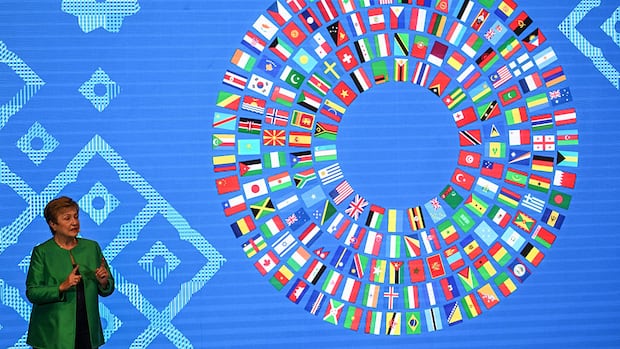

On Tuesday, the International Monetary Fund adjusted its global economic forecast slightly upward for this year, while cautioning about escalating risks tied to increasing debt, particularly related to the financial surge in artificial intelligence.
The IMF now anticipates a 3.1 percent growth rate for the global economy this year, an increase from its earlier July projection of three percent and notably lower than the expected 3.5 percent rise in 2025. Growth is projected to bounce back to 3.4 percent by 2027, as detailed in its most recent Economic Outlook.
As global economic and financial leaders convened in Bangkok for the fall meetings of the IMF and World Bank, the report indicates that the U.S. economy is expected to maintain a steady growth rate of 2.3 percent in both 2026 and 2027.
Advanced economies collectively are anticipated to grow by 2.1 percent this year, an increase from two percent in 2025, but are expected to slow down to 1.9 percent growth next year, according to the report.
These forecasts are predicated on an almost 41 percent surge in oil prices this year, averaging $96 per barrel. The IMF projects global inflation to be at 4.7 percent in 2026, but it expects this price growth to decline to 4.1 percent next year.
The predictions also rely on the expectation that oil and gas shipments through the Strait of Hormuz will resume by March, and that the surge in AI demand will stabilize.
Uneven effects of AI
According to IMF economists, the surge in artificial intelligence is compensating for the adverse effects of sharply rising oil and gas prices, though this technology presents its own set of risks.
The advantages of AI are not evenly distributed; the U.S. and China combined represent over three-quarters of the net demand for imports of computer chips and other AI-related technology, the report stated.
Silvana Tenreyro, the IMF’s research director, remarked to reporters in Bangkok, “The outlook is highly uneven.”
The report highlights that growth is increasingly concentrated, with just 32 countries responsible for 95 percent of global growth, a decline from 54 countries as of April.
“It is not merely a matter of the global economy slowing or accelerating; rather, growth is being redistributed among countries based on their vulnerability to the supply shocks caused by the war and the strength of AI-related demand,” it notes.

U.S. President Donald Trump is hosting a summit in Washington with the leading figures in AI development. Trump has dismissed concerns regarding artificial intelligence, emphasizing the need to outpace China in the AI arms race. Geoffrey Hinton, known as the ‘godfather’ of AI, claims Trump ‘doesn’t really understand’ the technology and is ‘ill-advised’ about it.
Athanasios Vamvakidis, deputy director of the IMF’s monetary and capital markets department, noted that a market correction related to AI is just one of the risks present. Rising bond yields present another evolving challenge, along with cyber threats that could disrupt financial systems.
Reinforcing these concerns, there were significant sell-offs of AI-related stocks across Asia on Tuesday, with South Korea’s Kospi index plummeting by as much as seven percent before closing down 5.5 percent.
The implications of AI on employment present another significant concern — described by IMF managing director Kristalina Georgieva as “a slow-moving tsunami, but a tsunami nonetheless.”
“We estimate that the long-term impact on jobs globally could reach around 40 percent — with roles either enhanced, diminished, or completely eliminated. We are already beginning to witness some of these effects,” she stated.
Concerns about debt persist
The IMF’s leader is calling on nations to enhance their financial management and address rising debt levels more effectively.
This is particularly vital in an era of elevated borrowing costs, noted Tenreyro.
Nations somewhat shielded from the energy shocks stemming from the Iran conflict and those benefiting from swift AI adoption are managing to sustain growth. However, developing economies and emerging markets that are more susceptible to rising oil and gas costs are projected to see growth slow to 3.7 percent this year from 4.5 percent in 2025, as per the report. It anticipates they will regain momentum in the following year, with an annual growth rate of 4.4 percent.
In contrast, the situation is significantly worse in the Middle East and Central Asia, where economies are expected to contract this year before bouncing back to a growth rate of 6.3 percent in 2027.
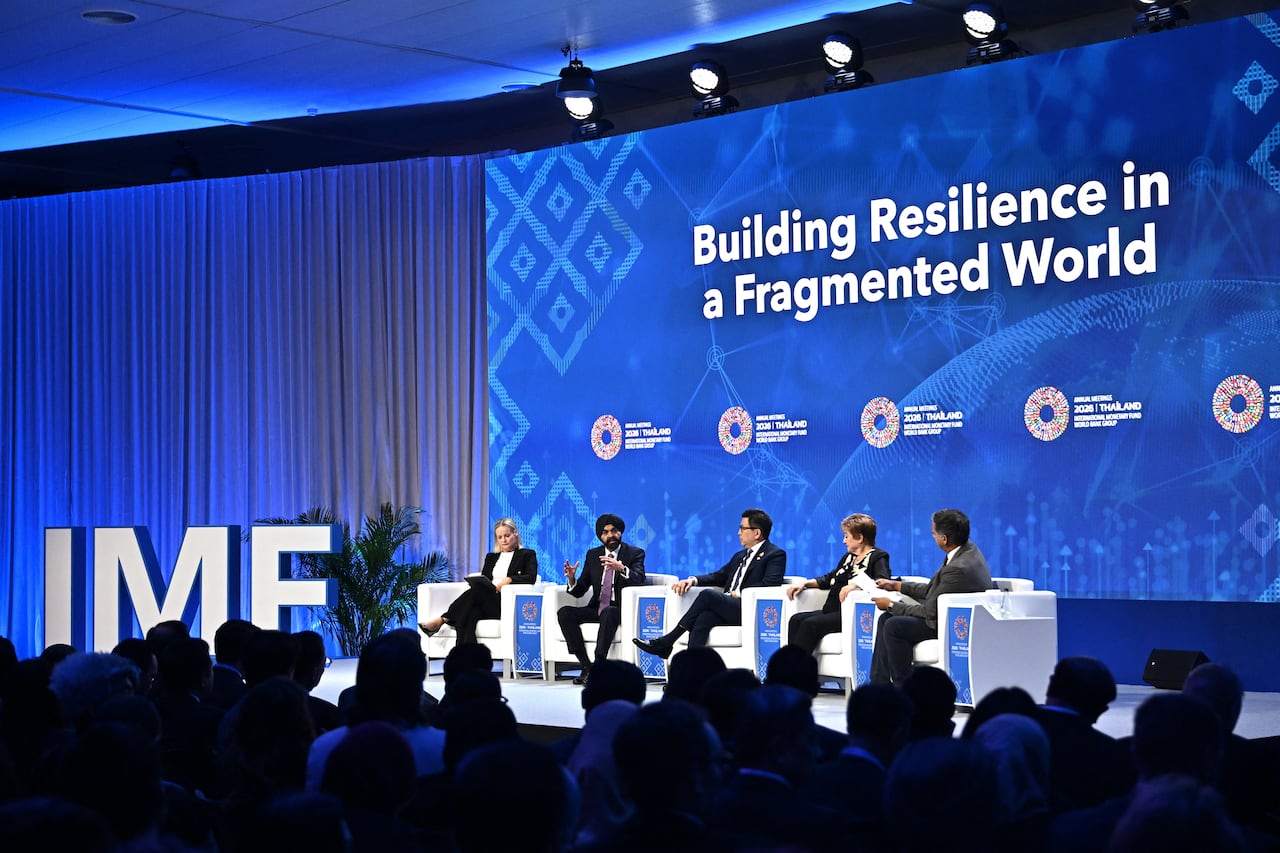
Finland’s Finance Minister and Deputy Prime Minister Riikka Purra, World Bank Group president Ajay Banga, Thailand’s Finance Minister and Deputy Prime Minister Ekniti Nitithanprapas, IMF managing director Kristalina Georgieva and BBC’s economics editor Faisal Islam participate in a panel discussion at the annual meetings of the International Monetary Fund and World Bank Group in Bangkok on Oct. 13, 2026. (Lillian Sunwanrumphaafp/AFP/Getty Images)
The 21 Eurozone countries are projected to experience a mere 1.1 percent growth this year, followed by a slight increase to 1.2 percent in 2027.
China, ranked as the second-largest economy globally, is forecasted to grow by 4.5 percent this year, down from five percent in 2025, aligning with the government’s official objectives.
India is once again expected to be the world’s fastest-growing major economy, with a growth rate of seven percent, a decrease from 7.7 percent last year.
The IMF, a lending institution with 191 member nations, aims to foster economic growth, ensure financial stability, and alleviate global poverty. During the meetings in Bangkok, finance ministers and central bank governors will evaluate the current state of the world economy and explore strategies to promote financial stability and sustained growth.