

Josh Wells, a student from Iowa, was eager to visit Montreal for his first journey beyond the United States. However, while browsing through Airbnb options, he started to observe some discrepancies.
Wells suspected that numerous hosts had profile images that were likely created by artificial intelligence.
“The typical person snapping an iPhone picture usually has some imperfections,” Wells expressed to CBC’s Cost of Living. “The AI-generated images just seemed overly flawless.”
Nevertheless, Wells continued his search. He was close to confirming a reservation for one property when a closer inspection of the listing’s pictures raised further concerns.
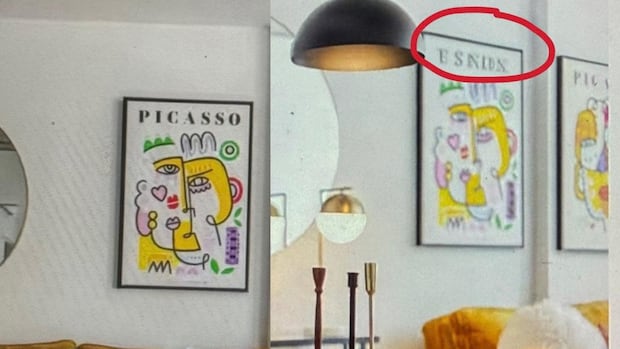
Upon zooming in on a piece of wall decor showing two halves of faces merged together, he noticed the artwork initially appeared to say “Picasso.” However, in another image of the same room taken from a different perspective, the artwork seemed altered.
“The text was all distorted and strange,” he remarked. “I thought, ‘Yeah, this is definitely AI.'”

While planning his trip to Montreal, Wells discovered that many Airbnb listings featured highly polished photos of hosts, leading him to suspect AI involvement. The city has stringent regulations for short-term rentals aimed at safeguarding the housing market. (Josh Wells/Reddit)
This was sufficient for Wells to decide against the listing — and ultimately, he chose not to use Airbnb for this trip. Unable to ascertain whether the photos truly represented an actual location or just an AI-created version, he decided on an apartment-style hotel instead.
“A fake profile picture is one thing, but listings for the actual place where you’re spending thousands of dollars was an immediate dealbreaker for me,” Wells stated.
Wells isn’t alone in his skepticism regarding whether images on Airbnb or similar short-term rental platforms accurately depict reality.
In July, a family from Ottawa revealed that their daughter arrived at a Toronto Airbnb only to find a room that looked markedly different from the listing images, which they suspected were either generated or heavily altered by AI.
They shared side-by-side images highlighting the discrepancies between the room and bathroom. Although Airbnb acknowledged that the listing did not correspond with the property and refunded the guest, they did not confirm the involvement of artificial intelligence.
As AI simplifies the alteration of photos, experts warn that travelers might increasingly struggle to determine if listings accurately represent reality, raising concerns about consumer trust and protections in Canada.
When a photo makeover goes too far
The rise of accessible, fast, and user-friendly AI tools is making photo editing more alluring, according to Francis Syms, associate dean at Humber Polytechnic’s faculty of applied sciences and technology in Toronto.
In addition to major AI platforms like ChatGPT, Claude by Anthropic, and Google’s Gemini, numerous other websites provide free tools for image modifications, Syms noted. For instance, Hugging Face hosts thousands of AI applications that allow users to upload and edit images.
“Within seconds, you can upload a picture to one of these sites and request that it removes smudges or alters the furniture,” he explained. “You’ll receive the modified image in about 30 to 60 seconds.”

AI platforms like ChatGPT enable users to quickly and effortlessly edit images. (Marco Bertorello/AFP via Getty Images)
Determining where AI editing transitions into deception can be complicated, according to Daniel Guttentag, an associate professor of hospitality and tourism management at the College of Charleston in South Carolina.
“If you add a fake hot tub on the patio, I think most would agree that’s a clear misrepresentation of what the unit offers,” he stated. “However, if you merely adjust the lighting a little… I believe many would find that acceptable.
“Yet there’s a considerable gray area in between, where it shifts into, ‘Wait, this isn’t what I signed up for.'”
Guttentag expressed concerns that AI-altered images could also be utilized to falsely show that guests have caused damage to a property, potentially resulting in compensation disputes.
In 2025, a guest from London, U.K., booked an Airbnb in Manhattan and was accused of causing over £12,000 ($22,665) in damages.
She contested the claim after spotting inconsistencies in images of a supposedly cracked coffee table, which she suspected had been digitally altered or generated by AI.
Initially, Airbnb claimed she owed more than £5,000 ($9,444), but later fully refunded her after the case received media attention.
Can you trust what you see online?
For Airbnb guests, relying on listing images to choose a property makes trust essential, Guttentag noted.
“You can’t try it out beforehand, like a pair of shoes,” he stated. “You need to have confidence and trust that it will meet your expectations.”
While AI-enhanced photos may aid hosts in securing bookings in the short term, if guests arrive to find something different from the advertised property, they may leave unfavorable reviews, Guttentag cautioned. If customers feel misled “one too many times,” he warned, it could lead them to abandon the platform entirely.

Daniel Guttentag is an associate professor of hospitality and tourism management at the College of Charleston in South Carolina, focusing on Airbnb and artificial intelligence in his research. (Submitted by Daniel Guttentag)
In a statement to CBC News, Airbnb noted that its policies mandate that listings must be “accurately represented” and that the company may request hosts to eliminate any content that utilizes AI or other digital technologies to “edit flaws, conceal damage, add amenities or attributes not included in the listing, or otherwise materially misrepresent the listing.”
Additionally, the company encouraged guests to report misleading listings and indicated that those who discover a property not matching its description can reach out to its 24/7 community support team. Under AirCover, Airbnb stated, it may assist guests in finding a similar location or provide a refund if the host is unable to resolve the issue.
In August, California implemented the Artificial Intelligence Transparency Act (CAITA), which mandates that AI-generated images, videos, and audio must include information to help consumers identify whether digital content was created or modified using AI.
A figurine in front of the logo of the AI assistant “Claude” created by the U.S. company Anthropic during a photo shoot in Paris on February 13, 2026. (Joel Saget/AFP via Getty Images)
Currently, Canada lacks specific legislation addressing misleading advertising related to AI, according to Steve Szentesi, a Toronto-based competition and advertising attorney. However, he noted that existing laws could already be applied to deceptive AI-generated images.
The federal Competition Act prohibits misleading advertising, regardless of whether the claims are made through text, images, audio, or other media. Similar protections are provided by provincial and territorial consumer protection laws.
Although AI-generated images are a relatively recent phenomenon, the core issue is not, Szentesi commented. Courts have been addressing disputes regarding real estate listings for years, including cases where property images did not match the actual home or contradicted listing descriptions.
For consumers who believe a short-term rental listing misrepresents a property, Szentesi recommends first addressing the issue with the rental platform. They also have the option to file a complaint with the Competition Bureau or their provincial or territorial consumer protection agency.
-
AI ‘slop’ is dominating menus, as some restaurant owners turn to it to save time and money
-
Can I get AI face? Plastic surgeons say AI-generated inspiration is more than meets the eye
In the meantime, Syms advises potential bookers to look for signs of AI-generated images in listing photos, such as uneven door frames, irregular tile lines and countertops, oddly shaped furniture, inconsistent shadows or reflections, and unclear or jumbled text on books or wall decor.
Travelers can also utilize tools like Google Lens to search for the same image online and verify if it has been sourced from another website rather than depicting the actual property.
For Wells, this experience hasn’t deterred him from using Airbnb entirely — he had a good experience booking through the platform in Kansas City back in March. However, his search for accommodation in Montreal has made him more cautious, he noted.
“I’m open to using it again as long as there are no phony AI listings involved.”