
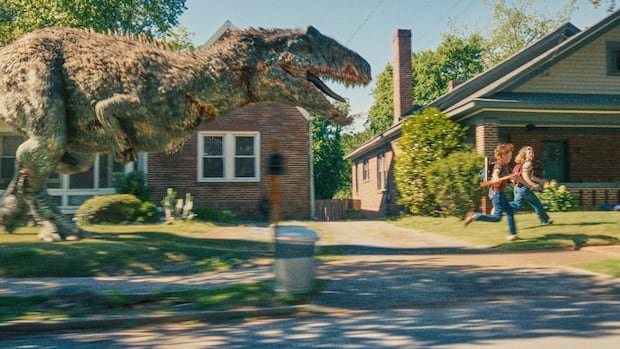

A massive serpent-like entity emerges from a nearby pool. A family is pursued by feathered lizards down their driveway. Two large furry creatures lean against a house and engage in mating behavior in “The End of Oak Street,” the latest film inspired by dinosaurs and a nostalgic affection for “Jurassic Park.”
Despite a longstanding presence in Hollywood, the prehistoric beings in the movie showcase a distinct departure from their cinematic predecessors, offering an anticipated revision from the standpoint of paleontologists. In this context, CBC News consulted experts regarding the accuracy of the movie’s portrayal of feathers and creatures, as well as the areas where filmmakers have extrapolated from a fossil record that still holds some fundamental unresolved queries.
One burning question remains: Did dinosaurs really reproduce in that manner?
From a scientific viewpoint, the emphasis lies elsewhere. “It was truly refreshing to witness an abundance of feathers on many dinosaurs in the film, a departure from what we typically observed, even in more recent ‘Jurassic World’ movies,” remarked Victoria Arbour, a paleontologist at the Royal B.C. Museum.
The depiction of dinosaurs in Hollywood has notably lagged behind scientific findings. The conjecture of a close connection between dinosaurs and birds emerged soon after the establishment of the theory of evolution. Fossil discoveries since the 1990s have significantly bolstered evidence that numerous non-avian dinosaurs sported feathers.
One pivotal discovery was Sinosauropteryx prima in China, the initial non-avian dinosaur with clear feather evidence. These findings transformed scientists’ visualizations of dinosaurs, a revelation largely obscured in mainstream culture by movies portraying scaly creatures popularized by Steven Spielberg’s “Jurassic Park.”
“The End of Oak Street” distinctly embraces feathers, a departure from the norm in dinosaur movies. The film’s feathered Allosaurus, often mistaken for a T. rex, is deemed plausible by researcher Caelan Libke due to its proximity to the bird-evolution lineage. Another smaller feathered creature, reminiscent of the “velociraptor role,” appears largely fabricated for the film but bears similarities to Elaphrosaurus.
Artistic liberties are evident in other creatures within the movie. The colossal legless aquatic creature may draw inspiration from the ancient snake Titanoboa, while the furry sauropods, a group that includes the contentious Brontosaurus, likely had less fur in reality.
The depiction of dinosaur mating rituals in the film, although unconventional given the creatures’ size, is not considered scientifically implausible. Director David Robert Mitchell explained the scene as a representation of dinosaurs leading complete lives beyond hunting activities.
Understanding the intricacies of dinosaur reproduction remains challenging due to the scarcity of soft tissue preservation in fossils. With limited evidence, paleontologists reconstruct behaviors cautiously, knowing that direct observation is unattainable and that fossilization typically favors skeletons over soft tissues. Consequently, the specific details of dinosaur mating behavior remain shrouded in mystery.
The depiction of dinosaur reproduction in “The End of Oak Street” didn’t strike experts as beyond the realm of possibility, considering the inherent uncertainties surrounding the subject. The film’s portrayal, while speculative, did not raise insurmountable scientific objections.