
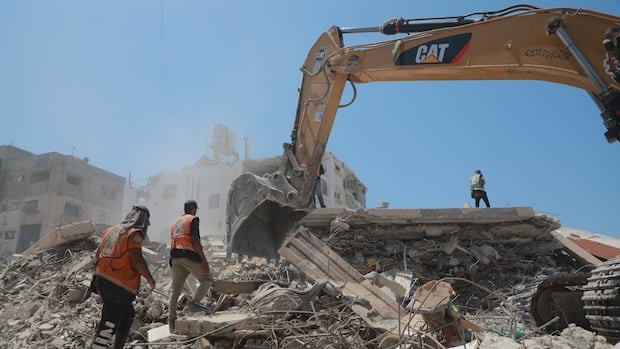

In Gaza City, members of the Al-Drimli family are engaged in a grim task, using basic tools like shovels, buckets, and a wheelbarrow to search through the debris of their former residence for the remains of a friend and neighbor. Under the scorching midday sun on Monday, the men work quietly, shielded by orange towels or sweatshirt hoods. The clatter of shovels striking rubble and the hum of an electric saw resonate through the air.
Transporting rubble in the dusty wheelbarrow to a nearby heap, the men struggle against the massive wreckage left behind by a six-story building that was struck by an airstrike in November 2023. Having already recovered the remains of their own family members, they now seek to find their neighbor who was present during the building’s destruction while seeking refuge.
According to the Gaza Health Ministry, an estimated 8,000 to 10,000 bodies remain buried under the debris nearly three years after the conflict between Israel and Hamas began. Due to the scarcity of excavators in Gaza, many Palestinians, including the Al-Drimli family, rely on manual labor as heavy machinery is both costly and scarce.
Ayman Al-Drimli expressed to CBC News freelance videographer Mohamed El Saife that the family resorts to manual labor due to the high costs and unavailability of equipment. Currently, Gaza Strip has only about a dozen barely operational excavators, which are challenging to maintain amidst a shortage of spare parts, oil, and fuel.
Operating two of the few remaining excavators in Gaza, Samir Sabra and his son Uday Sabra face financial constraints in running the equipment due to the exorbitant cost of essential resources like oil. The dire situation in Gaza has led to a surge in demand for their services, but the limited availability of equipment hampers their ability to cater to all requests.
Despite efforts by the Palestinian Civil Defence, the scarcity of excavators persists in Gaza due to the destruction of heavy machinery during the conflict. While the ceasefire agreement aimed to facilitate the entry of heavy equipment for debris clearance, the situation on the ground remains unchanged, prolonging the arduous task of retrieving bodies from beneath the rubble.
Moreover, humanitarian aid groups have highlighted Israeli restrictions on crucial supplies like fuel, oil, and spare parts, hindering the maintenance and operation of essential machinery in Gaza. The United Nations emphasizes that limitations on heavy equipment entry impede the recovery process, urging international intervention to expedite the provision of machinery to aid in the search and retrieval efforts.
Despite the challenges, Uday Sabra perseveres in his mission, determined to unearth the remains buried beneath the debris. He remains committed to providing closure to the deceased, ensuring they find peace amidst the devastation.