
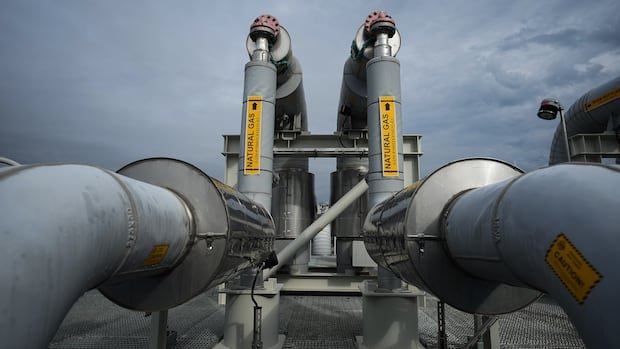

Prime Minister Mark Carney recently emphasized the significant role of Canada in driving American economic growth, particularly through the export of natural gas to the U.S. His remarks have sparked discussions on the potential consequences if Canada were to cease its gas shipments across the border.
Despite the ongoing trade tensions between Canada and the U.S., energy products like oil and natural gas have not been utilized as bargaining tools. While Alberta Premier Danielle Smith has consistently opposed such actions, Ontario’s Doug Ford has advocated for considering all options in trade negotiations.
Carney highlighted the vital contribution of Canadian energy supplies to the U.S., stating that Canada provides a substantial portion of their natural gas, electricity, and crude oil imports. The U.S. heavily relies on Canadian natural gas imports, with statistics from the U.S. Energy Information Administration revealing that almost all of America’s non-domestic natural gas supply comes from Canada.
According to Dulles Wang, director of Americas gas and LNG at Wood Mackenzie, Canadian natural gas shipments to the U.S. account for a relatively small percentage of America’s overall gas consumption. This trade flow is an integral part of the North American energy landscape, with Enbridge, headquartered in Calgary, being a key player as North America’s largest natural gas provider.
Wang emphasized the complex dynamics of natural gas trade between Canada and the U.S., highlighting the bi-directional flow of gas across the border. While the U.S. mostly imports Canadian gas for specific regional markets, it also exports gas to Canada, particularly in the eastern regions.
The potential impact of halting natural gas exports to the U.S. would be detrimental to the Canadian energy industry, leading to an oversupply situation and price drops. Wang warned against such a scenario, stating that cutting off the U.S. as a customer would severely harm Canada’s economic interests.
To diversify its energy export markets, Canada has been exploring opportunities beyond the U.S., such as sending liquefied natural gas to Asian markets. The government is supporting projects like the LNG Canada facility in Kitimat, B.C., and the Ksi Lisims LNG export facility to reduce dependence on the U.S. market and enhance energy export capabilities.
In conclusion, maintaining a balanced approach in energy trade relations is crucial for both Canada and the U.S. to ensure stability and economic growth in the energy sector.