
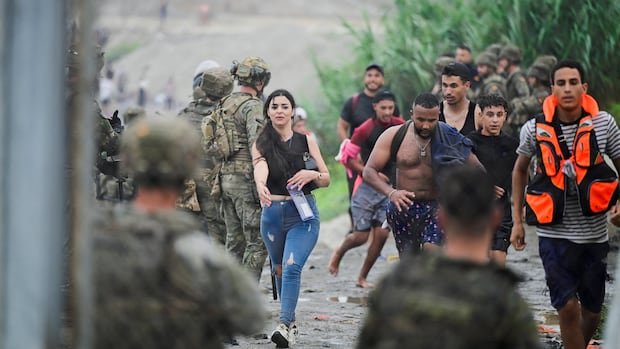

Spain and Morocco have fortified the border fence of a Spanish enclave, effectively reducing mass crossings after tens of thousands of individuals arrived by both sea and land within a day. The leader of the Spanish enclave in North Africa, Juan Jesus Vivas, informed reporters on Friday that at least 57 people had lost their lives during this period.
Spain’s Interior Ministry indicated that about 48,300 migrants had opted to return to Morocco voluntarily by 6 p.m. local time on Friday. The surge of people crossing into Ceuta, a small Spanish-held area protruding into the Mediterranean from Morocco, caused concern and discord in Europe. France announced an increase in border checks with Spain, while Italy mentioned the possibility of suspending Spain from the European Union’s internal open border scheme.
Moroccan authorities at the gates of Ceuta utilized water cannon trucks and physical force to repel individuals attempting to cross. They resorted to batons and tear gas to deter further border breaches, resulting in clashes that left a bus and seven cars charred. Despite a court ruling imposing restrictions on immediate expulsions from the enclave, Spanish authorities pledged to expedite the expulsion of those who entered unlawfully.
Prime Minister Pedro Sanchez of Spain, known for his opposition to anti-immigration sentiments prevalent in Europe, condemned the mass crossings as a violation of Spain’s territorial integrity. He urged Morocco to intensify efforts to stem the flow of people. Ceuta and Melilla, another Spanish autonomous city in northern Morocco, boast the European Union’s only land borders with Africa and often witness surges in migrant attempts to reach Europe.
Migration remains a contentious issue in Europe, especially with the rise of right-wing political parties. French Interior Minister Laurent Nunez announced a fivefold increase in police presence on the Spanish border, along with enhanced aerial surveillance and train patrols. Germany and Italy expressed concerns over illegal migration, with Italian Prime Minister Giorgia Meloni threatening the suspension of the Schengen Area with Spain to safeguard borders.
While acknowledging the economic contributions of immigrants, Spain’s Socialist government remains resolute against illegal crossings. The government highlights the positive impact of immigrants on the economy, supported by decades of data. Italy’s Foreign Minister criticized Spain’s mass amnesty offer, prompting a diplomatic exchange with Spain’s Foreign Minister emphasizing the need for solidarity over political rhetoric.
The recent events in Ceuta have sparked international debate and actions to address the challenges posed by mass migration, highlighting the complex and multifaceted nature of the issue.