
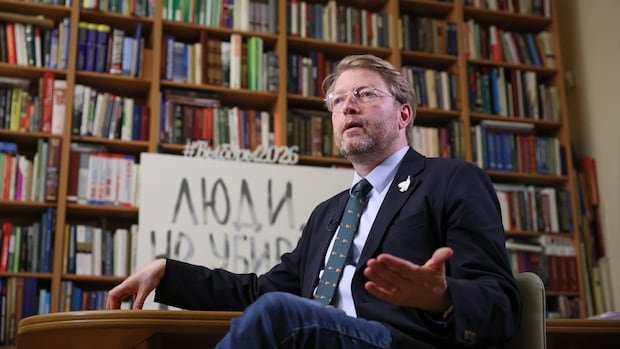

The head of Russia’s sole registered anti-war party has declared his determination to remain in the country and continue advocating for change, despite escalating pressure from authorities resulting in the party’s disqualification from the upcoming parliamentary elections. The Supreme Court’s recent ruling prohibited the post-Soviet liberal party Yabloko, meaning “apple” in Russian, from participating in the September vote. Yabloko’s leader, Nikolai Rybakov, expressed to Reuters that the decision was a reflection of the authorities’ unease over the party’s message to end the ongoing conflict in Ukraine resonating with the electorate.
Rybakov emphasized the significance of the overwhelming support from the public, which he deemed more crucial than the court’s verdict. Following the court’s decision, a crowd of supporters outside the court premises vocally voiced their disapproval, chanting “shame” loud enough for their sentiments to penetrate the courtroom walls. Once a prominent liberal voice in parliament and a government critic, Yabloko now holds only a few regional seats and lacks representation in the State Duma, where the Putin-backed United Russia party holds sway.
The forthcoming election will select members for the 450-seat lower house, with United Russia poised to maintain its dominance. Despite this, Rybakov asserted that Yabloko would present a stronger challenge than anticipated if permitted to participate. Yabloko is currently appealing the Supreme Court ruling, prompted by allegations of undisclosed campaign support from Western entities and other charges that the party refutes.
In his office, Rybakov conveyed that the recent attention was just the beginning, emphasizing that many individuals are now beginning to take notice. He underscored the authorities’ desire for public disillusionment and isolation, which he aimed to counter by fostering unity and shared beliefs among citizens. Despite stringent censorship laws and wartime regulations prompting numerous opposition figures to flee or face prosecution for dissent, the 47-year-old opposition stalwart affirmed his commitment to staying in Russia to effect change from within.
Public sentiment opposing the war is challenging to gauge due to stringent state controls on dissent. Still, the Levada Center reported a decline in support for Russian armed forces’ actions in Ukraine, with only 66% of Russians expressing approval in July, the lowest level since February 2022. Rybakov highlighted that Yabloko’s concise manifesto advocating for peace and a flourishing democratic Russia had resonated with a growing number of supporters, illustrating a significant societal desire for an end to the conflict.
The party has garnered widespread backing on social media platforms, with videos showcasing individuals displaying apples as a symbol of support for Yabloko. These posts, often devoid of overt political messaging, featured young individuals expressing their voting preferences for the upcoming election or engaging in dances to Russian tunes referencing apples.