
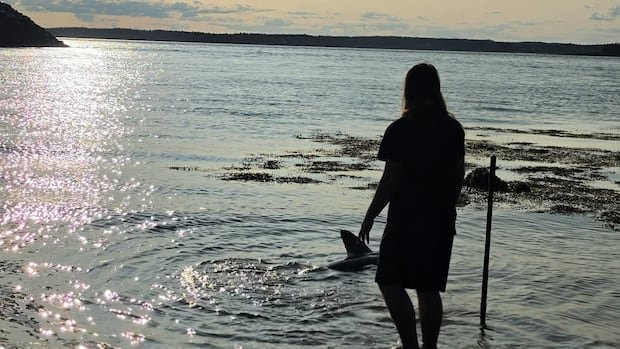

A teenager named Finn Holland, aged 15, has a strong passion for animals. When he learned that a shark had washed up on the shore near his residence in the coastal community of Maces Bay in southern New Brunswick, he felt compelled to assist.
On a Saturday evening, Holland and his family drove their side-by-side vehicle down the lengthy driveway leading to the beach at Maces Bay, situated southwest of Saint John.
Upon spotting the shark, Holland initially thought it was severely injured or possibly deceased. However, he noticed subtle movements.
He recounted, “It appeared really hurt, almost lifeless, but then we observed slight motions.” As a result, he took action by dragging the shark by its tail back into the ocean, assisting it in navigating the water, after which the shark swiftly swam away.
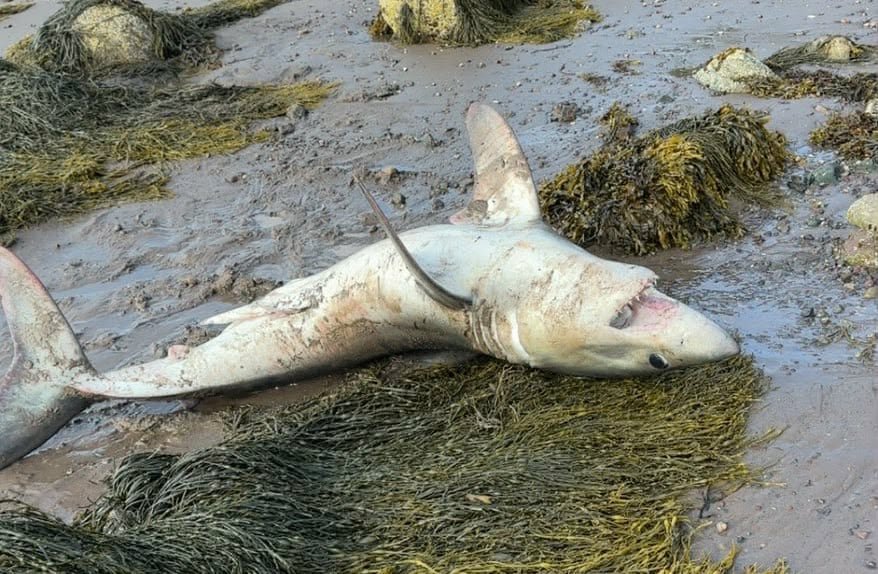
Holland initially hesitated to touch the shark due to its size, measuring approximately two meters in length and weighing about 70 kilograms. The species of the shark has been identified as a porbeagle shark.
Expressing his astonishment, Holland said, “I was stunned; it was so fascinating.”
Jill Holland, Finn’s mother, mentioned that her son’s impromptu rescue did not surprise her.
“It’s exactly the type of thing he would do, without hesitation, he just felt the need to go and save a shark,” she remarked.
She further added, “He took it upon himself, and I was very nervous.”
Having resided in the community for 11 years, Jill stated that there had been no prior reports of sharks in the area.
According to a shark expert, such sightings are uncommon.
‘Rare’ encounter, expert says
Neil Hammerschlag, the director of the Shark Research Foundation and president of Atlantic Shark Expeditions, commented that encounters like these, particularly in a natural setting without direct human interference like fishing, are infrequent.
He emphasized, “I believe that spotting a shark of that species is quite special.”

Hammerschlag explained that unlike most shark species, porbeagles can regulate their body temperature, enabling them to access cooler waters in regions like Atlantic Canada and New England.
However, he highlighted the surprising aspect of this encounter, noting that porbeagle sharks are not commonly found in shallow waters, suggesting that the shark might have been in distress.
“Possibly it was unwell or had an encounter with fishing gear, being caught and subsequently released,” he speculated.
Additionally, Hammerschlag mentioned that the declining population of porbeagle sharks over the years due to overfishing contributes to the rarity of such encounters.